
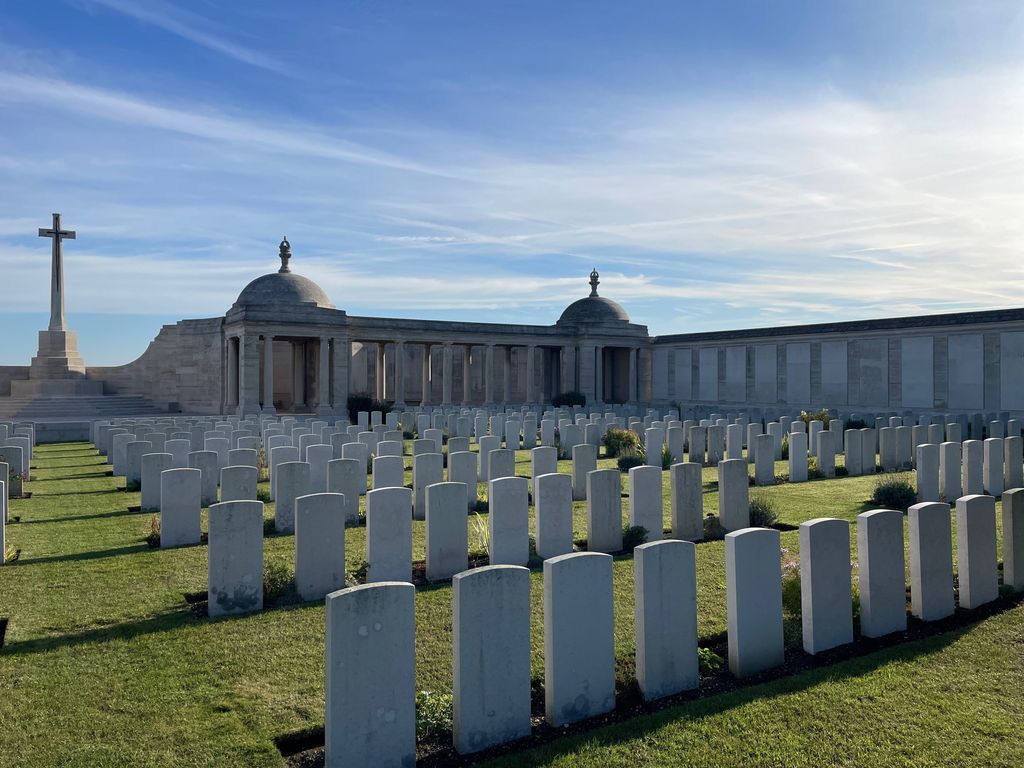
Taking a look at a branch of my husband’s family tree, I had previously noted the death of a 30-year-old man, Private 17400 William J. Horton, of the Gloucestershire Regiment, at Loos, France, on 25 September 1915. He left a widow, Rosa, and three young children, but beyond that I had few details.
I came across a blog today that listed him along with 10,291 others who died on that day, the worst day of the war thus far. So many casualties, in fact, that the blog could not list them all on one post – this is just part two. This prompted me to look more closely.
The CWGC site describes the four Battles of Loos including this one.
“The battle plan for Loos was approved in July 1915 by the commander of the British First Army. It was to cover a 10 km front, and the British assembled six infantry divisions (60,000 men) to face two German divisions (approx. 30,000 men). Allied heavy artillery went into action at 5.30 a.m., and the British army used poison gas in combat for the first time on French soil to support the infantry’s advance. “
“Two divisions (the 15th Scottish Division in the north-west and the 47th Division in the south-west) were deployed in front of Loos and took the town at heavy cost on 25 September 1915. The British continued the offensive on 26 and 27 September with several assaults, relieved by French troops on 29 September. “
“The offensive was halted on 14 October, but fighting continued until 19 October. Loos was back in Allied hands, at the cost of 60,000 British wounded, missing, and dead. The Battle of Loos definitively entered British history.”
This put William’s death into its sombre context for me and encouraged me to look further into what happened to the family. My husband had remembered that some Horton members had gone to the USA and sure enough, I found that Rosa had gone to the States and remarried. I now have a new line to follow and some more positive outcomes to report to my husband…














 Random Thoughts